Hasta 40% off y Envío a todo USA y PR por solo $2.99  Ver más

Enviar a
FL
0
es
  • argentina
  • chile
  • colombia
  • españa
  • méxico
  • perú
  • estados unidos
  • internacional

Selecciona tu país

América

Europa

Resto del mundo

Idioma
esEspañolActual
enEnglish
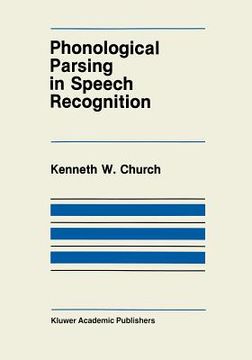
portada Phonological Parsing in Speech Recognition (en Inglés)
Formato
Libro Físico
Editorial
Idioma
Inglés
N° páginas
272
Encuadernación
Tapa Blanda
Dimensiones
10x7.01x0.59 in
Peso
0.50 kg.
ISBN13
9781461292005

Phonological Parsing in Speech Recognition (en Inglés)

K. Church (Autor) · Springer · Tapa Blanda

Phonological Parsing in Speech Recognition (en Inglés) - Church, K.

Más barato Libro Nuevo Origen: Estados Unidos
Envío: 9 a 11 días háb.
$ 109.99$ 93.49
-15%
Más rápido Libro Nuevo Origen: Estados Unidos
Envío: 8 a 10 días háb.
$ 123.74$ 116.46
-6%
Libro Nuevo Más barato

Quedan más de 100 unidades

$ 93.49
Llega entre el 01 Oct y el 07 Oct a FL. Seleccionar ubicación

Reseña del libro "Phonological Parsing in Speech Recognition (en Inglés)"

It is well-known that phonemes have different acoustic realizations depending on the context. Thus, for example, the phoneme /t! is typically realized with a heavily aspirated strong burst at the beginning of a syllable as in the word Tom, but without a burst at the end of a syllable in a word like cat. Variation such as this is often considered to be problematic for speech recogni- tion: (1) "In most systems for sentence recognition, such modifications must be viewed as a kind of 'noise' that makes it more difficult to hypothesize lexical candidates given an in- put phonetic transcription. To see that this must be the case, we note that each phonological rule [in a certain example] results in irreversible ambiguity-the phonological rule does not have a unique inverse that could be used to recover the underlying phonemic representation for a lexical item. For example, . . . schwa vowels could be the first vowel in a word like 'about' or the surface realization of almost any English vowel appearing in a sufficiently destressed word. The tongue flap [(] could have come from a /t! or a /d/. " [65, pp. 548-549] This view of allophonic variation is representative of much of the speech recognition literature, especially during the late 1970's. One can find similar statements by Cole and Jakimik [22] and by Jelinek [50].

Opiniones del libro

Preguntas frecuentes sobre el libro

Todos los libros de nuestro catálogo son Originales.
El libro está escrito en Inglés.
La encuadernación de esta edición es Tapa Blanda.

Preguntas y respuestas sobre el libro

¿Tienes una pregunta sobre el libro? Inicia sesión para poder agregar tu propia pregunta.

Opiniones sobre Buscalibre

Ver más opiniones de clientes