Venta Flash Hasta 60%  Ver más

Enviar a
FL
0
es
  • argentina
  • chile
  • colombia
  • españa
  • méxico
  • perú
  • estados unidos
  • internacional

Selecciona tu país

América

Europa

Resto del mundo

Idioma
esEspañolActual
enEnglish
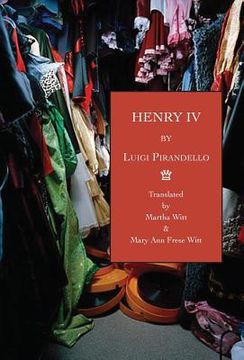
portada Henry IV: Followed by "The License" (en Inglés)
Formato
Libro Físico
Editorial
Idioma
Inglés
N° páginas
120
Encuadernación
Tapa Dura
Dimensiones
8.5x5.51x0.43 in
Peso
0.29 kg.
ISBN13
9781599102924

Henry IV: Followed by "The License" (en Inglés)

Luigi Pirandello (Autor) · Pirandello Luigi (Autor) · Martha Witt (Traducido por) · Mary Ann Frese Witt (Traducido por) · Italica Press · Tapa Dura

Henry IV: Followed by "The License" (en Inglés) - Luigi Pirandello

Más barato Libro Nuevo Origen: Estados Unidos
Envío: 10 a 12 días háb.
$ 35.00$ 32.94
-6%
Más rápido Libro Nuevo Origen: Estados Unidos
Envío: 7 a 9 días háb.
$ 40.63$ 38.24
-6%
Libro Nuevo Más barato

Quedan 100 unidades

$ 32.94
Llega entre el 01 Dic y el 07 Dic a FL. Seleccionar ubicación

Reseña del libro "Henry IV: Followed by "The License" (en Inglés)"

Luigi Pirandello's "Henry IV" opened to general acclaim at the Teatro Manzoni in Milan on February 24, 1922, less than a year after his revolutionary theatrical achievement, "Six Characters in Search of an Author." The title of the later play suggests a historical drama, recalling Shakespeare's great history plays. Yet "Henry IV" is instead anti-historical in that it "plays with" history, presenting historical events not as sequential and true, but as simultaneous and as an imaginary refuge. Henry IV (whose real name is not given) lives in a fake medieval castle where everyone must wear the costume of a historical figure. He is a twentieth-century Italian aristocrat whose madness traps him in the role of the Holy Roman Emperor, the German Henry IV, who reigned from 1056 until 1105. Numerous comparisons have been made between Pirandello's "Henry IV" and Shakespeare's "Hamlet." The affinities between their protagonists include madness, along with the pretense of madness, involving a consummate theatricality. Like other "mad" Pirandello characters, the man consumed by the role of Emperor Henry IV has been judged to be insane by a society that he judges to be insane. Madness, for Pirandello, can reveal a particular lucidity that gives access to truths not evident to "normal" people. Pirandello's one-act play "The License" ("La Patente," 1918), displays an earlier version of this theme. Its main character, Rosario Chiachiaro, may be mad or pretending to be mad as he also dons a costume and prepares to play a role for the rest of his life, the role of a purveyor of the "evil eye" - his means of self defense against a society consumed by hypocrisy and superstition. - "After the brilliant translation of "Six Characters in Search of an Author," Mary Ann Witt and Martha Witt return to Pirandello with yet a bigger challenge: translating the complex play "Henry IV" and placing it next to "The License," a much less performed work. The insightful and original introduction well supports this coupling, which is based on the theme of madness, so central in Pirandello's production. An absolute must read for understanding Pirandello's work." - Daniela Bini, University of Texas, Austin - "At once elegant and absorbing, subversive and vibrant, this superb translation of Pirandello's story of the bankruptcy of reason and of the seemingly pointlessness of life, is truly one ripping good read. Catching the humor of a desperately moving journey of self-invention and unpredictability, the translators skillfully succeed in bringing out Pirandello's bleak and yet life-affirming creation of alternative worlds in a drama that - just like the short one-act play that accompanies it - tells us much about the human condition and the society's role in policing it." - Valeria Finucci, Duke University A new English translation with introduction, notes and bibliography.
Luigi Pirandello
  (Autor)
Ver Página del Autor
Luigi Pirandello nació en el seno de una familia acomodada. Cursó sus estudios superiores en Palermo, Roma y Bonn. Volvió luego a Italia para ejercer de profesor de Literatura en la Escuela Normal Femenina de Roma, puesto que dejaría cuando su creciente reputación le permitió dedicarse en exclusiva a su carrera como escritor. Pirandello comenzó escribiendo poesía y relatos cortos, pero es fundamentalmente conocido por su faceta como dramaturgo.
En sus obras volcó todas sus ideas filosóficas y se permitió explorar la psicología humana por medio de personajes populares en un novedoso lenguaje teatral que dejaba atrás las convenciones tradicionales. Ya como autor reconocido, fue nombrado director del Teatro d’Arte de Roma en 1925 y miembro de la Real Academia de Italia en 1929.
En 1934 recibió el Premio Nobel de Literatura por su «audaz e ingeniosa renovación del arte dramático y escénico». Aunque la figura de Pirandello quedó ligeramente empañada por sus lazos con el fascismo de Mussolini, su brillante trayectoria lo sitúa como el más importante dramaturgo de la Europa de entreguerras y uno de los grandes innovadores del teatro del siglo xx, cuya visión vanguardista sigue estando vigente hoy en día.
Ver más
Ver menos

Opiniones del libro

Preguntas frecuentes sobre el libro

Todos los libros de nuestro catálogo son Originales.
El libro está escrito en Inglés.
La encuadernación de esta edición es Tapa Dura.

Preguntas y respuestas sobre el libro

¿Tienes una pregunta sobre el libro? Inicia sesión para poder agregar tu propia pregunta.

Opiniones sobre Buscalibre

Ver más opiniones de clientes